
- July 28, 2026
- By tr_admin
- Gutter Replacement
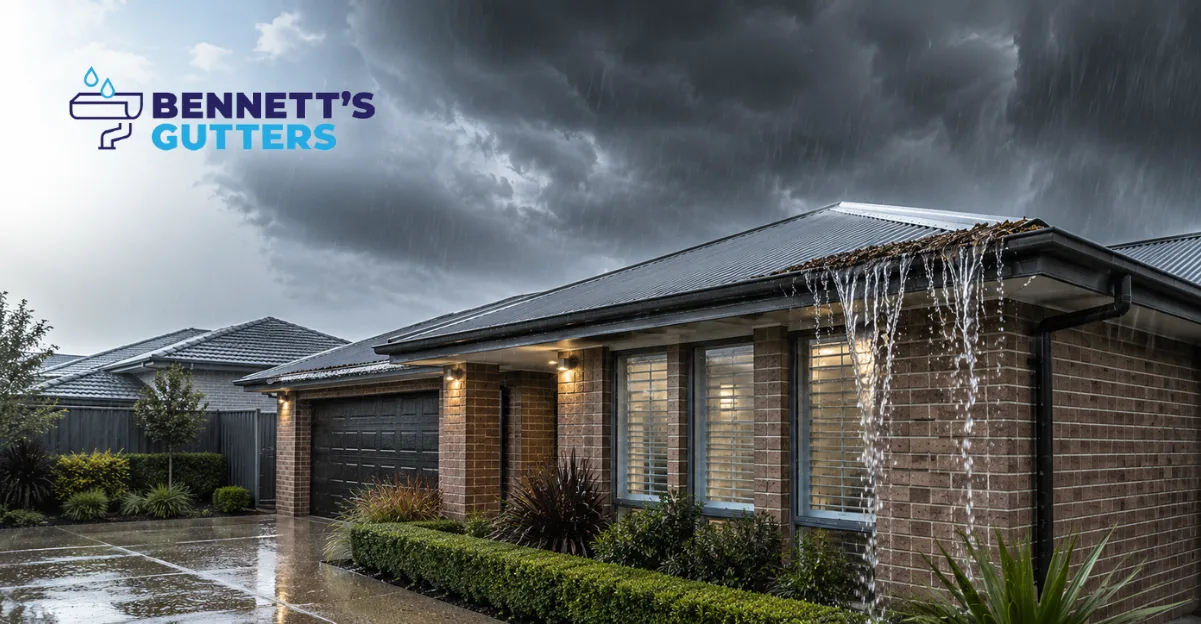
A gutter overflowing in heavy rain is not just a minor inconvenience. Water spilling over the gutter edge saturates the soil against your foundation, can enter subfloor spaces, and causes long-term structural damage. In Melbourne’s South East, storms regularly deliver 20 to 40 mm of rain in under an hour, enough to expose any weakness in a gutter system.
The most common causes of gutter overflow
- Blocked gutters: Leaf litter, seed pods, and roof grit reduce water flow capacity significantly. Eucalyptus trees, common across Melbourne’s outer suburbs, shed bark and leaves year-round. A 5-metre section of debris-filled gutter can lose more than half its drainage capacity. Bi-annual cleaning is not optional in these conditions.
- Incorrect fall: Gutters must slope toward the downpipe at approximately 2 mm per metre to drain under their own flow. Gutters that have settled flat or were installed without adequate fall hold standing water and overflow at their lowest points during rain.
- Undersized gutters: Many Melbourne homes built before 1990 have 100 mm quad or half-round gutters. AS/NZS 3500.3:2018 calculates gutter sizing based on roof catchment area and rainfall intensity. A roof extended by a pergola or addition may now exceed the drainage capacity of the original gutters.
- Too few downpipes: One downpipe serving a long gutter run cannot drain fast enough in heavy rain. The practical guide from AS/NZS 3500.3:2018 suggests one downpipe per 6 to 12 metres of gutter depending on roof area and pitch.
- Blocked downpipes: A clear gutter connected to a blocked downpipe overflows identically to a blocked gutter. Always check downpipe flow before assuming the gutter is the problem.
How to diagnose the cause
Run a garden hose into the gutter at the end farthest from the downpipe. If water overflows at the gutter end, the fall is incorrect or the gutter is partially blocked. If it backs up at the downpipe inlet, the downpipe is the problem. If the gutter fills evenly and overflows along its full length, the gutter is undersized for the volume it receives.
What repairs fix each cause
- Cleaning: A professional gutter clean costs $100 to $250 for a standard single-storey home and resolves most overflow caused by debris accumulation.
- Adjusting fall: A licensed roof plumber resets bracket heights to restore the correct slope. Cost: $150 to $400 depending on the run length.
- Upgrading gutter size: Replacing 100 mm gutters with 150 mm hi-capacity gutters costs $1,500 to $3,000 for a single-storey home.
- Adding a downpipe: Installing an additional downpipe costs $200 to $500 including the stormwater connection.
Bennett’s Gutters diagnoses the actual cause of overflow before recommending any repairs across South East Melbourne and the Mornington Peninsula. Call 0402 473 771 or email quote@bennettsgutters.com to book a free assessment.
Prevention tips for Melbourne homeowners
Clean gutters at least twice a year: once in autumn after leaf fall and once in spring before the storm season begins. Install gutter mesh if your property has large overhanging trees. Mesh reduces cleaning frequency but requires annual inspection to ensure debris has not accumulated on top of the mesh. Check gutter brackets each year. A bracket that has pulled away from the fascia causes the gutter to lose its fall angle and creates a low spot that holds water.
Frequently Asked Questions
Why does my gutter overflow only at one specific spot?
A single overflow point usually means a blocked downpipe inlet, a depressed bracket creating a low spot, or a failed joint allowing water to escape before reaching the downpipe.
Are gutter guards worth installing in Melbourne?
Gutter guards reduce debris volume but do not eliminate maintenance. Low-profile mesh systems reduce cleaning frequency from twice yearly to every two to three years for most Melbourne properties.
Can overflowing gutters damage my home's foundation?
Yes. The Australian Building Codes Board identifies uncontrolled stormwater discharge against a building’s foundation as a primary contributor to subfloor moisture problems in Australian homes. Consistent overflow also accelerates deterioration of external brick and render.